Living in the Simulacrum
Case Studies of Modern Media (un)Realities
In the contemporary world, the simulacra has profoundly impacted how we interact in spaces and places “real,” digital and in between. These case studies delve into the intricate world of simulacra, realities blur in mediated spaces. The case studies are explored in depth in Living in the Simulacra: How I Learned to Stop Worrying and Love Baudrillard, MIT Press (2026). Please click on the Discover More tab below to order the book.
Case Study: Future Nostalgia is Here
Dua Lipa and Baudrillard were right
Pix or it Didn’t Happen
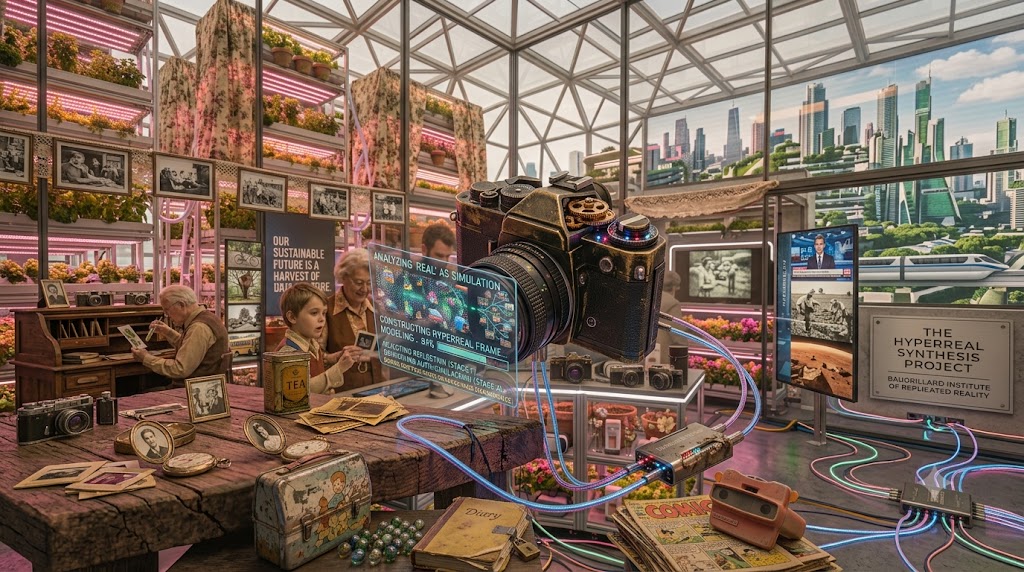
In Living in the Simulacra’s chapter 3, “Pix or it Didn’t Happen,” the authors consider the idea of digital intervention crafting “truths” that occur at the press of a button, in this case, the taking of a picture on a cell phone.
Dua Lipa released “Future Nostalgia” – the Grammy winning and chart topping (14 countries) – album in 2020, a pop confection incorporating themes of feminism, self empowerment, modernism and longing. This notion of “what could be” not only inspired dance and music audiences, it entered into the public imaginary at a particular moment of possibility. Contemporarily, hardware capability and software ubiquity had opened spaces for forward-looking opportunists to reshape the present past, or, craft future nostalgia.
Google Pixel’s version 8 and 8 pro were released a few years later and made “concrete” those alignments of past, present and future via the inclusion of the Magic Editor (a 2023 debut feature). This built-in feature allowed for taking of images that could be edited to reimagine the photos using AI. Thumb in the image? No problem, just “brush” that digit away using the Magic Editor. Not close enough to that stately monument? Magic Editor can “move” you to appear exactly where you like in proximal relationship to the object (or person).
The feature was highly touted in an advertisement that aired during NBC’s coverage of the Macy’s Thanksgiving Day Parade in 2023. In the narrative arc of the broadcast commercial, a girl is at some remove from one of the parade’s start attractions – the iconic kick dancing troupe, Radio City Music Hall Rockettes. Mom takes a photo of the girl some distance away from the dancers then moves or merges the child to appear as if she’s within touching distance of the century-old precision dance team. When shown the images on the small screen, the child gleefully chirps, “Mom, I’m a Rockette!” To which the mother responds, “That’s you girl!” That moment, that never was, is now immortalized for daughter and parent and, presumably a circle of friends to recall a memory that never happened. This is just one small sliver of an instance – definitionally, the nature of what a photographic image captures- of Baudrillard’s conception of living in the simulacrum. It is discussed with numerous additional examples in chapter 3 of Living in the Simulacrum: How I Learned to Stop Worrying and Love Baudrillard.
If you’re reading this and recalling this sort of photo manipulation taking place historically, notably during the Soviet Union State censorship era, that is a reflecting back on the past that may conjure thoughts of manipulation, erasure and information control. Then and now, tools of promise and possibility and the products they create, like an edited image, shape meanings and memories that fuel Future Nostalgias.
Teaching Tool
As we navigate a media landscape dominated by simulacra, the broad considerations below might create ideas. Call it bubble gum for the brain.______________________________________________________________
1. Are photos facts?
2. If photos, or video, are facts, can you believe your eyes?
3. What are the ethical challenges for media producers who may create ads like the one mentioned above?
4. How can media literacy combat the effects of simulacra?
5. How can audiences discern reality from simulacra?
The Simulacra Effect on News Perception
No Results Found
The page you requested could not be found. Try refining your search, or use the navigation above to locate the post.
The Influence of Simulacra in Advertising
Advertising has evolved into a realm where simulacra dominate, shaping consumer perceptions and behaviors. In this section, we delve into how advertisements create hyper-realities that blur the line between genuine needs and manufactured desires. By examining case studies, we reveal how brands construct images that resonate with consumers on a subconscious level, often prioritizing illusion over authenticity. This exploration highlights the power of simulacra in crafting narratives that captivate and influence audiences, ultimately redefining the consumer experience.

Digital Interactions and Simulacra
The Virtual Reality of Social Media
In the digital age, simulacra have profoundly impacted how we interact online. Social media platforms and virtual communication tools have created environments where the boundaries between reality and representation are increasingly blurred. This section examines how digital avatars and curated online personas contribute to a new form of social interaction, one that often prioritizes appearance over substance. By analyzing these digital landscapes, we uncover the complexities of identity and connection in a world dominated by simulacra, offering insights into the implications for personal and societal relationships.
Dive Deeper into the Simulacra
Unlock the secrets of the digital age by exploring our comprehensive case studies. Discover how simulacra shape your world and redefine reality. Ready to challenge your perceptions?